
Do You Need a Qualitative Fit Test for School? What New Students Should Know
If you are starting a healthcare, medical, dental, emergency services, or clinical training program, your school may require you to complete a respirator fit test
Respiratory physicals ensure employees who are exposed to respirable toxins are properly protected and help employers make informed decisions about which employees can use respirators under specific environmental conditions and physical demands.
A respiratory medical evaluation can help detect if wearing a respirator will limit or interfere with breathing, vision, communication or use of other required equipment.
Employers must provide respiratory protection to their employees when such equipment is necessary to protect the health of the employee against breathing airborne containments.
Before wearing a respirator, workers must first be medically evaluated by a Physician or Licensed Health Care Provider (PLHCP). Respiratory medical evaluations are required every one to two years, depending on the respirator type, job type, the employee’s health status, environmental conditions, and other regulatory requirements.
At CNS OccMed, we help ensure that companies remain in compliance with the to the OSHA respiratory protection standard, OSHA 29 CFR 1910.134.
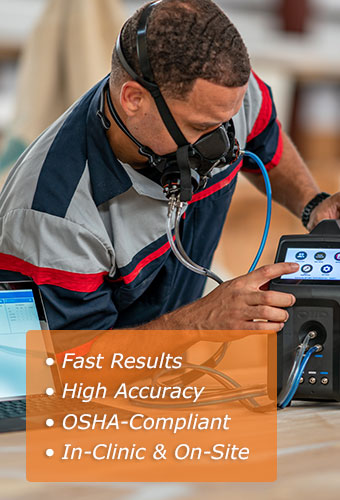
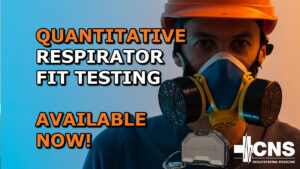
Quantitative Fit Testing uses an instrument to measure the exact amount of air that leaks into a respirator while it’s worn.
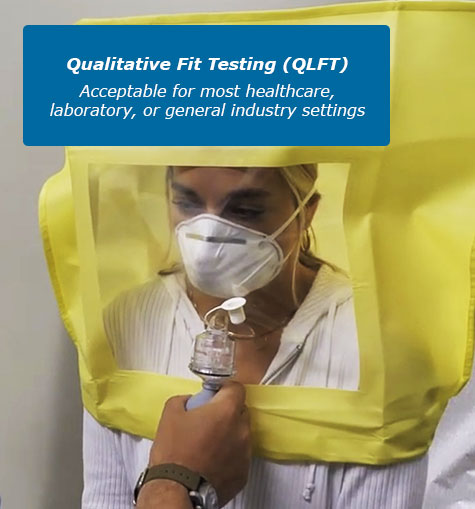
Qualitative Fit Testing is a pass/fail test method that uses your sense of taste or smell to detect leakage and is typically used for respirators such as N95s or other disposable filtering facepiece respirators.
Our Occupational Medicine Team follows a specific process for every employee that receives a Respirator Fit Test.
*CNS OccMed will provide this form to the employer ahead of time for completion
*These services can be provided by the CNS OccMed Team and most can be performed on the same day of the screening
We also offer many other Physicals, Screenings and Tests and Employer Services from Biometric Screenings to Work Injury Treatment Plans.
We offer a number of screenings, tests, and other medical services from Biometric Screenings to Vaccinations to X-Rays, and more.
We offer a number of physicals related to DOT, Non-DOT Medical Services, and OSHA-Related work, such as DOT Physicals, Respiratory and HAZMAT/HAZWOPER Physicals, and more.
We offer services for all different types of employers, whether you are regulated by DOT, OSHA or any other government organization. We can manage your Work Injury Treatment Plans.
Our On-Site Clinics can be utilized in one of two ways, On-Site Clinical Staffing or Mobile Clinics. This means we can either send a team of staff members to your place of business and use your facility to administer services or they can perform the services in our Mobile Clinics.
Our On-Site Clinical Staff are contracted to perform the medical services you need, when you need them, utilizing your facility spaces.
Our medical staff will coordinate with you to determine the best place to set up our Mobile Health Clinic as well as how long you would need the unit.
Our Occupational Healthcare staff members specialize in Respiratory Physicals and are ready to answer any questions you have whether you need In-Clinic Services or Onsite Clinic Services. All medical staff has very specific knowledge in Occupational Medicine, which is exactly what you need.
Please be advised that all articles, blogs and written material are not intended to replace the advice of a physician.
Before an employee uses a respirator, even if use is voluntary in many cases.
A standardized form used to determine if an employee can safely wear a respirator.
Yes, if the N95 is required by the employer.
Initially and whenever workplace conditions, health status, or respirator type changes.
No. A medical evaluation clears the employee medically; fit testing ensures the respirator fits properly.
Only if acting under a licensed healthcare provider’s supervision, per OSHA rules.
No. Providing respirators alone does not meet OSHA requirements. Employers must also have:
Medical clearance for respirator use
A written respiratory protection program
Annual fit testing
Proper respirator selection based on exposure
A respirator that doesn’t fit correctly does not protect the worker.
Most violations are not intentional. They usually stem from:
Misunderstanding Action Level requirements
Not conducting exposure monitoring
Missing medical surveillance triggers
Incomplete respirator programs
These gaps can create serious health risks and compliance exposure.
Allowing respirator use before medical clearance is completed.
The most effective approach includes:
Exposure monitoring
Action-Level-triggered medical surveillance
Proper respirator selection
Annual fit testing (quantitative when possible)
Clear documentation
This layered approach protects workers and creates a defensible compliance program.

If you are starting a healthcare, medical, dental, emergency services, or clinical training program, your school may require you to complete a respirator fit test

OSHA is targeting engineered stone. In this article we break down why Silica Testing and Fit Testing can’t wait and why Quantitative Fit Testing is

Did you know? We can come to you for corporate On-Site (mobile) quantitative fit testing. Respirators only work as well as they fit. Whether your