Do You Need a Qualitative Fit Test for School? What New Students Should Know
If you are starting a healthcare, medical, dental, emergency services, or clinical training program, your school may require you to complete a respirator fit test
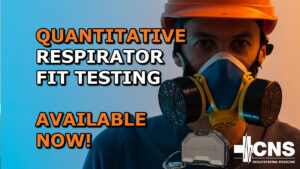
At CNS Occupational Medicine, we provide both Quantitative and Qualitative Respirator Fit Testing to keep your employees protected and compliant with OSHA 1910.134 requirements.
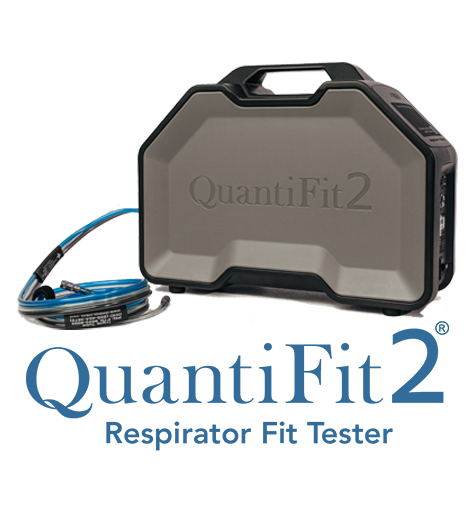
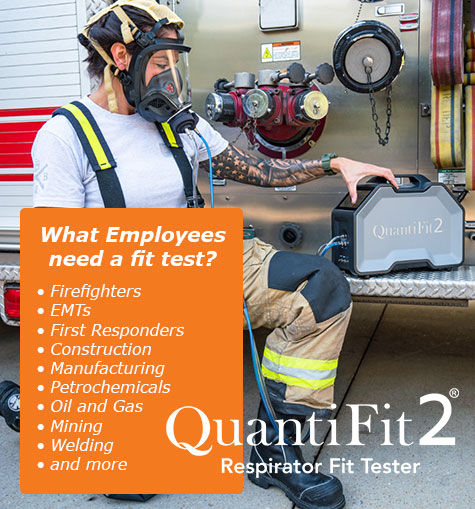
We are proud to use the Quantifit2, the most advanced Quantitative Fit Testing device on the market, providing faster, more accurate, and more reliable results than any other system available today.
Whether your team comes to our clinic or needs testing at your facility, we make it easy to complete respirator fit testing for individuals or large groups — in-clinic or on-site.
Respirator fit testing ensures that a tight-fitting respirator properly seals to an employee’s face to prevent exposure to hazardous airborne contaminants. OSHA requires that all employees who wear tight-fitting respirators receive a fit test prior to use and annually thereafter.
Fit testing verifies both the seal quality and the proper respirator size and model for each employee.
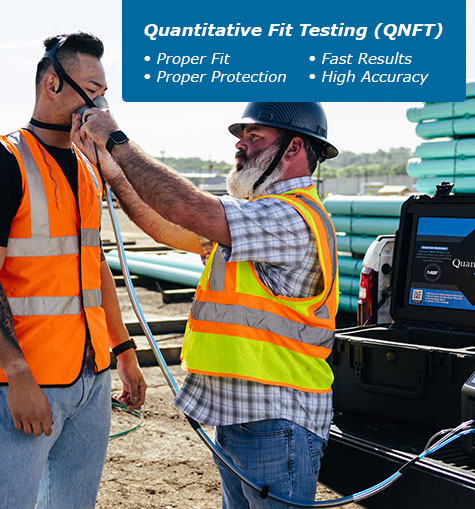
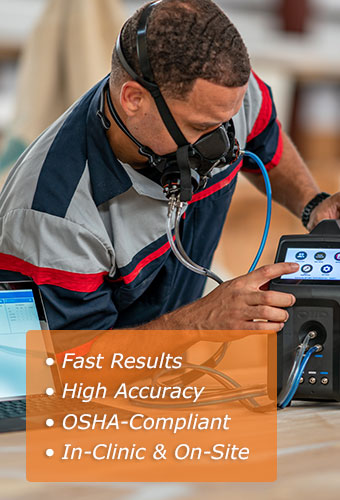
Quantitative Fit Testing uses an instrument — in our case, the Quantifit2 — to measure the exact amount of air that leaks into a respirator while it’s worn.
Benefits of Quantitative Fit Testing:
Our Quantifit2 fit testing system is ideal for firefighters, first responders, HazMat, and industrial workers who rely on full-face or half-mask respirators.
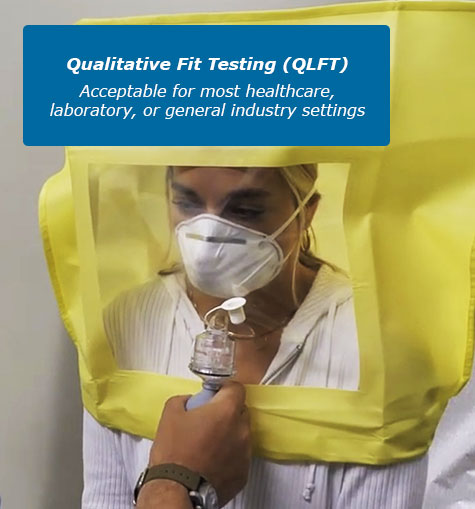
Qualitative Fit Testing is a pass/fail test method that uses your sense of taste or smell to detect leakage and is typically used for respirators such as N95s or other disposable filtering facepiece respirators.
This test meets OSHA 1910.134 standards and is suitable for many healthcare, laboratory, or general industry settings where qualitative testing is permitted.
If your employees are required to wear any tight-fitting respirator on the job and rely on respiratory protection, OSHA mandates a respirator fit test and annual fit testing to stay OSHA-compliant.
Common professions and industries include:
Types of Respirators We Test
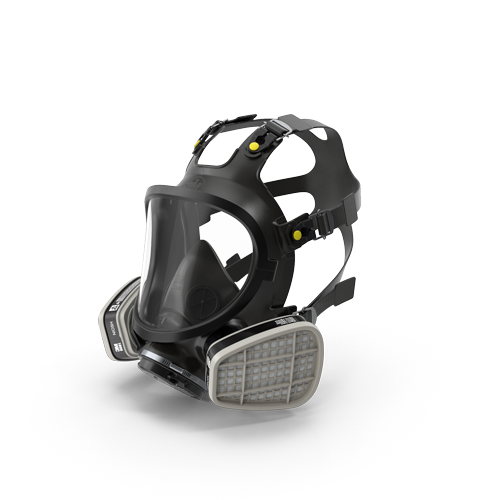
CNS Occupational Medicine performs both quantitative and qualitative testing on nearly every type of tight-fitting respirator used in fire service, industrial, healthcare, or emergency response settings.
This includes, but is not limited to:
We also offer many other Physicals, Screenings and Tests and Employer Services from Biometric Screenings to Work Injury Treatment Plans.
We offer a number of screenings, tests, and other medical services from Biometric Screenings to Vaccinations to X-Rays, and more.
We offer a number of physicals related to DOT, Non-DOT Medical Services, and OSHA-Related work, such as DOT Physicals, Respiratory and HAZMAT/HAZWOPER Physicals, and more.
We offer services for all different types of employers, whether you are regulated by DOT, OSHA or any other government organization. We can manage your Work Injury Treatment Plans.
Our On-Site Clinics can be utilized in one of two ways, On-Site Clinical Staffing or Mobile Clinics. This means we can either send a team of staff members to your place of business and use your facility to administer services or they can perform the services in our Mobile Clinics.
Our On-Site Clinical Staff are contracted to perform the medical services you need, when you need them, utilizing your facility spaces.
Our medical staff will coordinate with you to determine the best place to set up our Mobile Health Clinic as well as how long you would need the unit.
Our Occupational Healthcare staff members specialize in Respirator Physicals and are ready to answer any questions you have whether you need In-Clinic Services or Onsite Clinic Services. All medical staff has very specific knowledge in Occupational Medicine, which is exactly what you need.
Please be advised that all articles, blogs and written material are not intended to replace the advice of a physician.
Before first use, annually thereafter, and whenever the respirator type or facial structure changes.
Qualitative Fit Testing relies on the employee’s sense of taste, smell, or irritation to detect leaks. It is a pass/fail test often used for:
This method still meets OSHA 1910.134 requirements where permitted, but it’s not allowed for all respirator types or high-hazard environments.
Quantitative Fit Testing uses advanced equipment to measure the exact amount of leakage into the respirator. It provides a numeric fit factor and removes all subjectivity from the test.
CNS Occupational Medicine proudly uses the Quantifit2, the most advanced respiratory fit testing device available. It provides:
Often required for full-face respirators or when higher protection factors are needed.
No. A medical evaluation must occur before fit testing.
No. Facial hair that interferes with the respirator seal is prohibited.
Yes, provided it is conducted by trained personnel using OSHA-accepted protocols.
Until the next fit test is administered.
Allowing respirator use without documented fit testing.
Failure to link fit testing, medical clearance, and exposure documentation.

If you are starting a healthcare, medical, dental, emergency services, or clinical training program, your school may require you to complete a respirator fit test

OSHA is targeting engineered stone. In this article we break down why Silica Testing and Fit Testing can’t wait and why Quantitative Fit Testing is

Did you know? We can come to you for corporate On-Site (mobile) quantitative fit testing. Respirators only work as well as they fit. Whether your