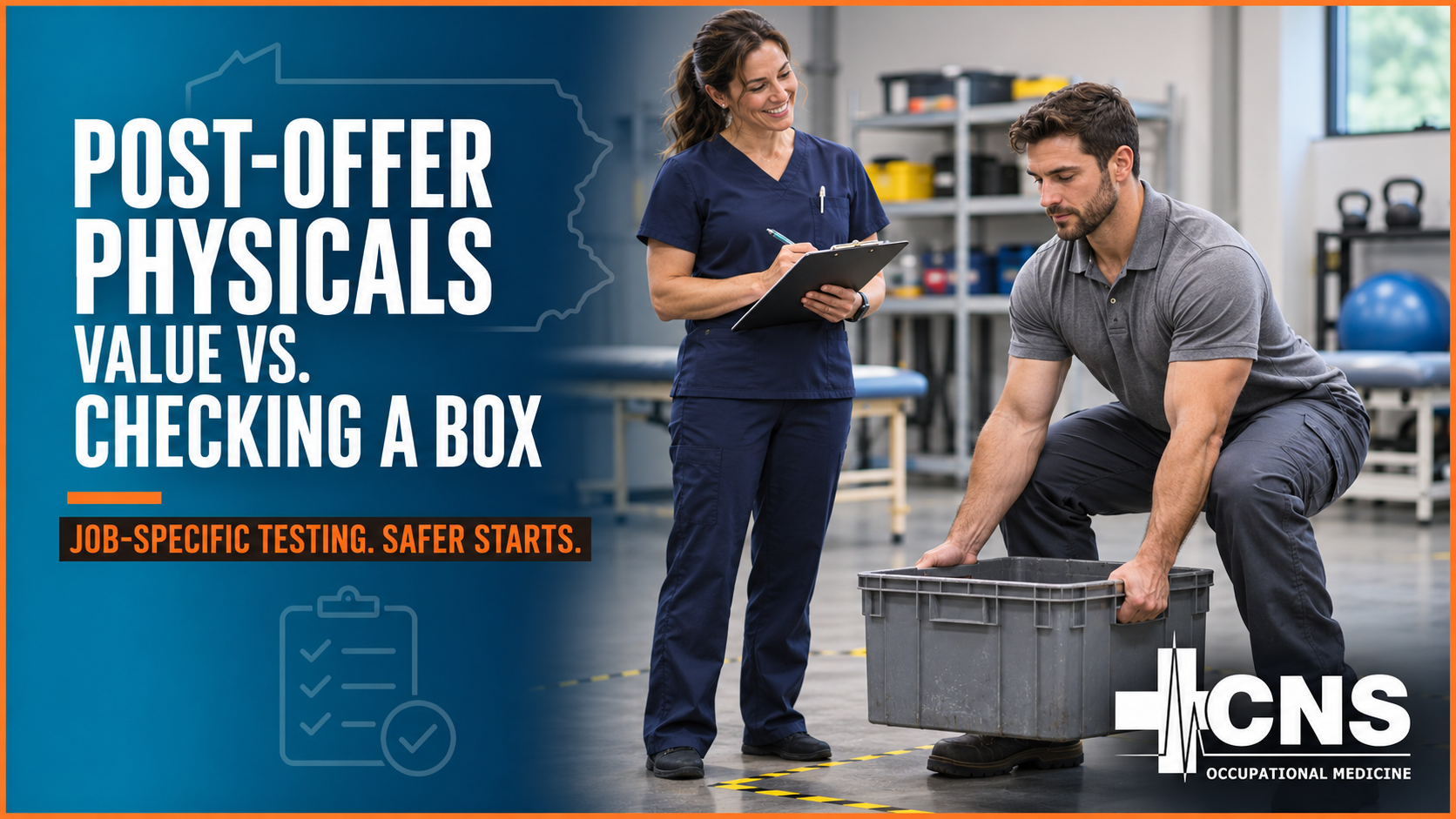
A post-offer physical should do more than check a box. Learn how the right program cuts injury risk, sets baselines, and supports compliant hiring.
In Pennsylvania, a preexisting medical condition that gets aggravated at work can become a compensable workers’ compensation claim.
Read that again if you work in HR or safety. The bad back. The old shoulder injury. The knee that’s been acting up for years. If the job makes it worse, it can become your claim.
That’s why a post-offer physical deserves more attention than it usually gets. Too many employers treat it as a formality. Blood pressure, a quick listen to the lungs, a signature, and the new hire starts Monday. Box checked.
But a box checked isn’t a risk managed.
What a post-offer physical should do
A strong post-offer physical does three things.
- It confirms the candidate can safely perform the essential functions of the job, with or without reasonable accommodation. Not a generic job. This job. The one where they lift 50 pounds overhead all shift or climb in and out of a cab 30 times a day.
- It identifies significant safety risks tied to the job. A condition that’s no issue in an office role can be a serious concern for someone running a forklift or working at heights.
- It sets an accurate medical baseline before day one. That baseline documents where the employee started. If a claim comes up later, you have a clear record of what was there on the first day and what changed on the job.
None of that works if your provider doesn’t know what the job requires.
Your provider should know your jobs
When did your occupational medicine provider last tour your facility? When did they last review your job descriptions or the physical demands of your roles?
If the answer is never, your post-offer physicals are built on guesswork. A provider who has never seen your loading dock can’t tell you whether a candidate can handle it.
The best programs start with the job. That means written job descriptions that spell out essential functions. It means documented physical demands for each role: lifting, carrying, pushing, climbing, and time on their feet. It means testing that matches those demands, such as Post Offer Employment Testing (POET) and physical ability testing; and it means baseline testing where the work calls for it, like audiograms for employees in high noise environments.
Do it right and do it compliant
Post-offer physicals come with rules. Under the Americans with Disabilities Act, you can require a medical exam after a conditional job offer. But it must apply to every entering employee in the same job category. Results stay confidential and separate from personnel files. And if you withdraw an offer based on the results, the reason must be job related and consistent with business necessity.
That’s another reason the job analysis matters. Accurate, documented job demands are what make your placement decisions defensible.
A DOT physical isn’t the same thing
This one is for fleets. A DOT physical determines whether a driver meets federal medical standards to operate a commercial vehicle. It doesn’t tell you whether that driver can unload freight, work a lift gate, or climb on and off a trailer all day.
If your drivers do physical work beyond driving, a DOT medical card alone leaves a gap.
Now consider the ROI
The National Safety Council puts the cost of a single medically consulted work injury at $48,000. Compare that to the cost of a thorough post-offer physical. One preventable injury can cost more than years of comprehensive post-offer physicals.
So, the real question isn’t what your program costs. It’s what it delivers.
The value shows up in injuries that never happen. Claims that are easier to evaluate. Placement decisions you can stand behind.
How CNS approaches post-offer physicals
At CNS Occupational Medicine, our work goes beyond our clinic walls. We run clinics in Lititz and Harrisburg, PA and Sussex County, DE. Our embedded onsite teams work inside client facilities across multiple states. We know the jobs because we see them every day.
Our mobile trucks and audiogram units bring testing to your site. And because we work alongside the CNS DOT compliance team, we understand the regulatory side as well as the clinical side.
We also treat your new hires the way you’d want them treated. Fast, friendly, and respectful. Their first visit for your company should never feel like a trip to the DMV.
If you’re not sure your post-offer physicals reflect the real demands of your jobs, let’s find out. CNS will review your job descriptions and post-offer protocols and show you where the gaps are. Contact us at info@cnsoccmed.com or visit www.cnsoccmed.com.
Post-Offer Physicals FAQs
1. What is a post-offer physical, and why is it important?
A post-offer physical is a medical examination performed after a candidate receives a conditional job offer. It helps evaluate whether the candidate can safely perform the job’s essential functions, with or without reasonable accommodation. A well-designed program also identifies job-related safety concerns and establishes a medical baseline before work begins.
2. What should a post-offer physical include?
The evaluation should reflect the specific job’s physical demands, including lifting, carrying, pushing, climbing, and prolonged standing. Depending on the role, it may include a medical history review, physical examination, job-specific physical ability testing, and baseline testing such as an audiogram. Employers should provide accurate job descriptions so the provider can match the evaluation to the work.
3. How can post-offer physicals help reduce workplace injury risk?
Post-offer physicals help identify potential mismatches between a job’s demands and a candidate’s abilities before work begins. Those findings can support appropriate placement and reasonable accommodation decisions. Documenting an employee’s starting medical condition can also help providers evaluate later injuries, although a baseline does not prevent a workers’ compensation claim.
4. What is the difference between a DOT physical and a post-offer physical?
A DOT physical determines whether a driver meets federal medical standards for operating a commercial motor vehicle. A job-specific post-offer physical evaluates demands that may extend beyond driving, such as unloading freight, operating a lift gate, or climbing onto trailers. For physically demanding driving positions, the two evaluations serve different purposes.
5. How can employers make their post-offer physical program more effective?
Start with current job descriptions that clearly document essential functions and physical demands. Work with an occupational medicine provider who understands your workplace and can design appropriate evaluations for each role. Periodically review testing protocols as jobs change, apply examinations consistently within the same job category, and keep medical results confidential and separate from personnel files.